The St. Louis Option
Defeat is not inevitable

I have a complicated relationship with Rod Dreher’s book, The Benedict Option. When the book was released nearly a decade ago, it caused quite a stir in the broader Christian community. On the one hand, Dreher’s diagnosis of the problem Christians face in an increasingly secularized culture was spot-on. Post-Christian society, long foretold by prophets, pundits, and critics is indeed upon us. One might point to various causes (or are they merely symptoms?): The Sexual Revolution, the hegemony of consumer capitalism, the rise of transhumanist ethics among our technological elite, the replacement of the concept of sin with the concept of irredeemable political ideas. But no Christian person who has eyes to see the world as it is can reasonably deny that the culture has shifted against us. In fact, the commanding heights of our civilization—education, media, law, medicine, science, literature, politics—seem almost to be organized around the concept of counter-formation. That is to say, they form our worldview, our belief systems, even our consciences in ways that are inimical to the Gospel message. Thus, even “good Christian parents” lament that their children are turned against them, absorbing the dogmas of the new religion either by osmosis or with the fervor of the converted. The shock troops of the new religion are always Janissaries.
It is not Dreher’s diagnosis that so troubles me, but his prescription. When the book first came out, I—like many others—interpreted it as a kind of quietism. A surrender or retreat into the wilderness. Like Benedict of Nursia, Dreher argued, we must isolate ourselves from the toxicity of the culture around us, building new communities and institutions that might survive the inevitable collapse.
But how to do this in the modern era, with its universal digital media and its tentacular “democratic” governments that brook no dissent on matters of dogma? Could American or European Christians find land and build even a single new city, with laws and cultural norms rooted in tradition rather than consensus? Would they be permitted to withdraw their children from public education? Could they find gainful employment that did not require them to conceal their faith? It seemed not only implausible, but weak, dare I say “effeminate?” Where, I wondered, was the conquering spirit that infused the early Christianity of St. Benedict? Where was the call to sanctify the culture, to convert? Where, for that matter, was the basic human instinct to defend one’s home and family against invasion?
The public discourse around Dreher’s book happened to overlap with one of the many unfortunate, inevitable outbreaks of iconoclasm that always seem to accompany puritanical crusades. In the American West, states of Junipero Sera were torn down over his alleged racism and colonialism. In the South, Reconstruction was revived, as various Confederate generals were ritually humiliated. There was a time when it seemed no statue more than a decade old was safe.
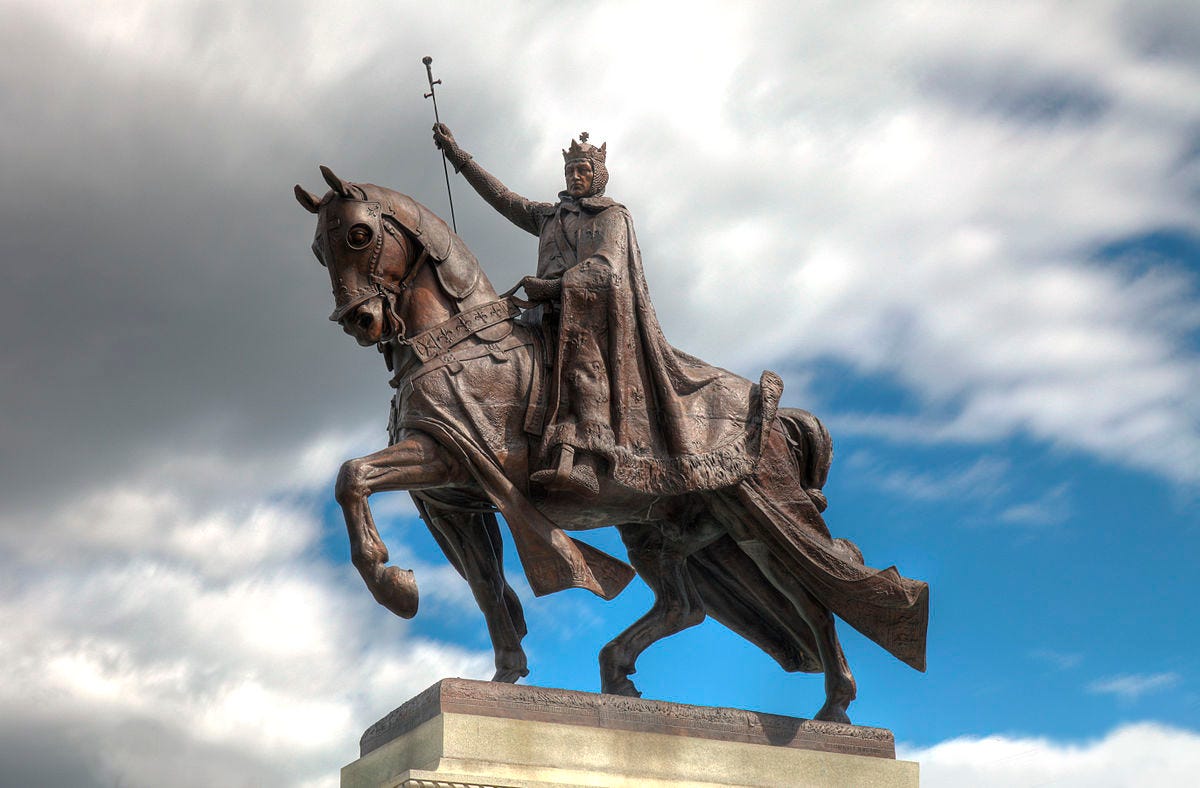
The iconoclasts came to my hometown of St. Louis, too, targeting a statue of our namesake the King of France. Led by a Muslim activist (who, I hasten to add, I consider to be not only a good man but a good friend as well), they decried the saint’s various crimes and shortcomings, even going so far as to suggest that the city should be renamed. They desecrated the statue with graffiti and threatened to pull it down in the middle of the night. They organized protests, though I wonder if a mob of people shouting at politicians to do the very thing those politicians most want to do can be properly labeled a protest. The mayor, the city council, and the police seemed poised to acquiesce to their demands.
Then, something quite unexpected happened. Local Catholics began gathering at the statue to pray. Mind you, the statue is not inside a church but in the largest public park in the city, just in front of the art museum. There, St. Louis King of France sits astride his destrier, sword raised and looking out over the rolling green below. I was curious, so I went to investigate.
To my astonishment, the group of Catholics at the foot of the statue grew larger every day. They prayed the rosary. They said the Chaplet of St. Michael the Archangel. They sang the Salve Regina. It became a kind of perpetual adoration, with laypeople, priests, and religious alike taking shifts around the clock.
The other side, evidently not persuaded of the need for their own Benedict Option, did not retreat. On the contrary, they organized counter-protests, at times surrounding the praying Catholics and shouting abuse at them and threatening violence. The police showed up, sometimes having to separate the two sides. So did the news media. I noticed something else, then: the crowd of watchers.
There are always watchers. Watchers, in fact, are the largest crowd of all, whether they are physically present or not. There is no such thing as a private act of resistance, because resistance is by definition an act of intellectual violence against the citadel. Certainly, the citadel knows this, which is why it tries so hard to suppress resistance, to ridicule it, to de-legitimize or even outlaw it.
The story of what happened over the next few weeks is not mine to tell. It belongs to the people who organized, resisted, prayed, sang, and ultimately prevailed. I was merely a watcher. And yet watchers, too, play a role. They bear witness. They talk about what happened. They are either strengthened or weakened by what they see. They carry the memory of the events with them, and that memory shapes their own future actions in mysterious ways.
The victory of the Catholics of St. Louis was a seminal moment in my life. It solidified an intuition that defeat was not inevitable. Rather, it was a choice. We do not have to surrender to the mob or cede the moral high ground to those who despise us. We do not have to retreat into the wilderness. There may come a day when The Benedict Option is the only one available, but at present, the better path is the St. Louis Option: resist, pray, and be public about it.
As with all such controversies, it vanished as quickly as it appeared. The statue was saved. The mob moved on to another, less well-defended target. Looking back on it, it feels almost like a dream. I suspect that what JRR Tolkien called “eucatastrophe” always feels like that.
Some years from now, the mob will probably return. They may even win. But the lesson of St. Louis is that we need not surrender. The bonds that were formed during that time will endure. It is possible—perhaps even probable—that some souls among the watchers were saved. What victory could be more profound and enduring than that?
Someone should write a “The Basil Option”, or a “The Ambrose Option”, or even a “The Augustine Option”, and so on. The Church Fathers were known as some of the most contemplative men who ever existed, and also some of the most socially active.